

ZEALS Completes Japan's First Humanoid Robot Proof-of-Concept at University of Tsukuba Hospital
プレスリリース

TOKYO, March 26, 2026 — ZEALS Co., Ltd. (Headquarters: Meguro-ku, Tokyo; CEO: Masahiro Shimizu; hereinafter "ZEALS"), developer of Omakase Robotics, in collaboration with Quick Co., Ltd. (hereinafter "Quick"), a University of Tsukuba-born venture, successfully conducted a three-day demonstration experiment using the humanoid robot "Unitree G1" at the University of Tsukuba Hospital from March 23 to March 25, 2026.
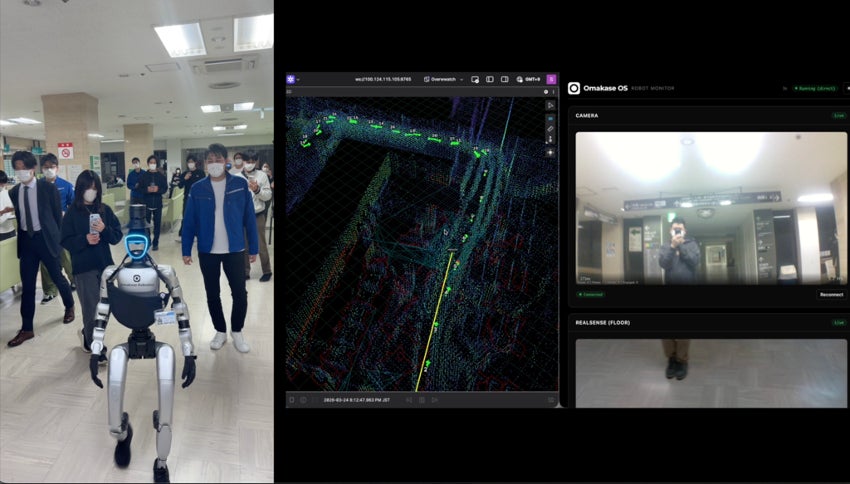
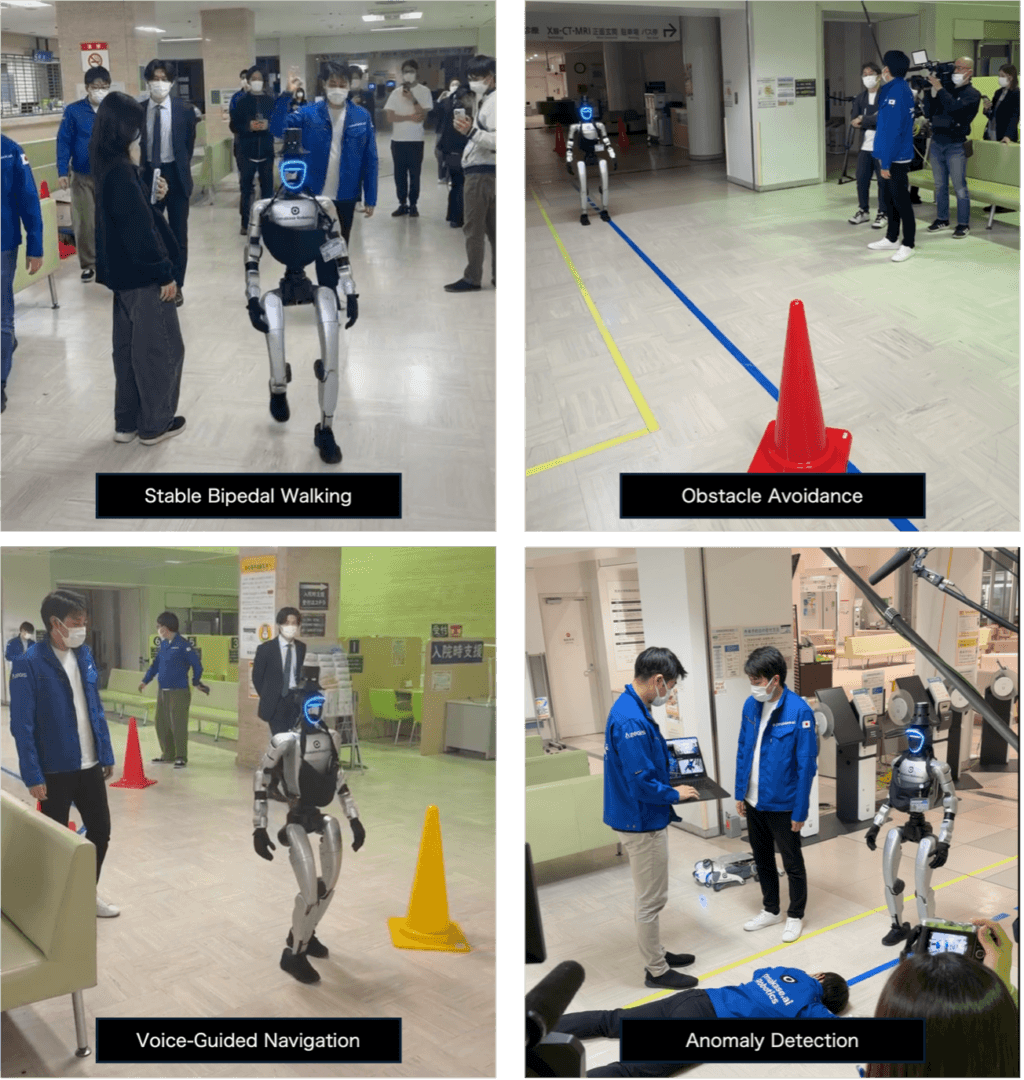
Equipped with ZEALS' proprietary robotics operating system, "Omakase OS," the humanoid robot was tested on its ability to perform autonomous walking, obstacle avoidance, voice-guided navigation, delivery tasks, and other support functions within the hospital. The successful completion of all key demonstration objectives marks a significant milestone toward the practical implementation of humanoid robots in future medical settings.
Background of the Demonstration
The medical field faces chronic labor shortages. Beyond specialized clinical duties, healthcare professionals are burdened by indirect tasks such as facility patrol, patient navigation, and logistics. These tasks place a heavy physical and temporal strain on staff, particularly during night shifts when personnel are limited.
To maintain the quality of care, it is becoming essential to support these indirect tasks through technology, allowing medical professionals to focus on human-centric patient care. This collaboration combined Quick's deep understanding of medical site challenges with ZEALS' expertise in conversational AI and "Omakase OS"—an intelligence layer designed to enable robots to understand context and behave appropriately within human spaces.
Scope of the Experiment
The experiment took place in the first-floor lobby of the University of Tsukuba Hospital between 19:00 and 21:00 (after outpatient hours). Key testing areas included:
Locomotion Stability: Navigating the specific floor environment of the hospital.
Obstacle Avoidance: Identifying and bypassing traffic cones and pedestrians.
Autonomous Navigation: Moving from the entrance to specific destinations, such as the blood collection room.
Service Tasks: Voice-guided navigation and item transport.
On the final day, Dr. Yuji Hiramatsu (Director, University of Tsukuba Hospital) and Dr. Kiyotaka Nemoto (Assistant Director) observed the demonstrations and provided feedback from a clinical perspective.
Results and Future Outlook
Despite minor technical issues, such as a temporary power interruption to the speakers, the robot successfully completed all planned test items. The hospital staff expressed high praise for the smoothness of the robot's movement and interaction. The parties also discussed expanding use cases to other indirect medical tasks based on real-world needs identified during the trial.
Executive Comments
Dr. Yuji Hiramatsu, Director, University of Tsukuba Hospital: "We felt the concrete potential for humanoid robots to play a role in healthcare. I was impressed by the smoothness of the robot's movement and dialogue. As a hospital that validates and implements new technologies, we intend to proactively consider the possibility of actual deployment within the next one to two years."
Atsuhiro Takeda, CEO of Quick Co., Ltd.: "Our mission is to create a 'continuously evolving medical infrastructure.' This demonstration gave us a strong sense that we are finally reaching areas that software alone could not fully address. We aim to create an environment where robots can work efficiently by seamlessly linking them with our hospital management systems."
Masahiro Shimizu, CEO of ZEALS Co., Ltd.: "While humanoid hardware is evolving rapidly, hardware alone is just a 'large remote-control car.' It requires intelligence to understand contexts and recognize people to perform real work. 'Omakase OS' serves as the robot's 'soul,' enabling it to function as a colleague in human spaces."
*As of March 25, 2026, based on internal research of public information regarding the integrated verification of autonomous bipedal walking, obstacle avoidance, voice guidance, and delivery by a Unitree G1-based general-purpose humanoid robot in a Japanese hospital.